Retaining Wall Repair vs. Replacement: 7 Signs Your Retaining Wall Is Failing
A retaining wall can stand for years before you notice problems. Maybe one section starts leaning slightly. A few blocks separate. Soil begins collecting at the base after heavy rain. At first, these changes may seem cosmetic, but they can also point to drainage issues, soil movement, the wall's base, or the original construction.
For Pittsburgh homeowners, deciding what to do next is not always straightforward. Some retaining wall problems may be limited enough to repair. Others can indicate that larger portions of the wall need to be rebuilt.
The key question isn't simply whether the wall looks damaged. It is why the wall changed in the first place.
Repairing visible damage without addressing the cause can allow the same problem to return. A professional retaining wall evaluation can help determine what is happening behind, below, and around the wall before you decide whether repair or replacement makes more sense.
Here are seven signs of retaining wall failure to watch for.
1. Your Retaining Wall Is Leaning
A retaining wall should not noticeably lean outward toward the lower side of the property. If you can see that the top of the wall is moving farther outward than the bottom, pressure behind the wall may be causing it to shift.
Several factors can contribute to a leaning retaining wall, including:
- Excessive soil pressure
- Water pressure behind the wall
- Inadequate reinforcement
- Poor base construction
- Soil movement
- Improper wall design
The amount of movement matters. A small problem affecting an isolated section differs from a wall leaning along most of its length.
Other conditions also matter, including the wall's height, surrounding slope, drainage, nearby structures, and how quickly the movement has developed.
Can a Leaning Retaining Wall Be Repaired?
Sometimes. Whether a leaning wall can be repaired depends largely on why it moved and how much movement has occurred.
A limited problem may potentially be corrected if the rest of the wall remains stable. Widespread leaning, however, may require dismantling sections of the wall so you can address soil, base, drainage, or other underlying problems.
Simply pushing the wall back into position does not correct the conditions that caused it to move.
2. The Wall Is Bulging or Bowing
A bulging retaining wall often looks different from a uniformly leaning wall. Instead of the entire structure shifting in one direction, one portion may push outward.
You might notice:
- A middle section extending farther than the surrounding wall
- Blocks that no longer form a straight surface
- Individual sections pushed outward
- Changes in the wall's shape that were not previously present
Bulging can indicate that pressure is building behind a particular portion of the wall.
Water and saturated soil may contribute to that pressure, but other factors can also be involved. The wall may have insufficient reinforcement, base problems, shifting soil, or construction issues.
Moving the visible blocks back into place may temporarily improve the appearance, but you still need to identify the source of the pressure.
3. Blocks or Stones Are Separating
Some small changes can occur as outdoor structures age. Growing gaps between retaining wall materials deserve closer attention.
Separation may appear between:
- Concrete retaining wall blocks
- Natural stones
- Wall caps
- Different sections of the wall
A few small gaps don't automatically mean the retaining wall is failing. Increasing separation, particularly when it appears with other changes, can indicate movement below or behind the wall.
Look for related problems such as soil appearing through the gaps, water flowing through new openings, loose caps, or sections of the wall sitting at noticeably different angles.
These signs can help a retaining wall contractor determine whether the issue is limited to individual materials or related to movement within the wall system.
4. Soil Is Washing Out From Behind the Wall
Soil accumulating near the bottom of a retaining wall is worth investigating, especially if the amount increases after storms.
Other signs of soil loss can include:
- Holes developing behind the wall
- Mulch washing through openings
- Low areas forming above the wall
- Exposed landscape fabric
- Planting beds that repeatedly wash out
A retaining wall depends on the conditions around it, not just the visible materials. When backfill or surrounding soil begins washing away, the wall can lose support.
Soil loss also indicates that water may not be moving through the property as intended.
Repairing an opening where soil is escaping may not be enough. A contractor may need to determine where the water is coming from, how it moves across the property, and whether drainage improvements are necessary.
5. Water Is Collecting Behind or Around the Retaining Wall
Drainage plays an important role in retaining wall performance.
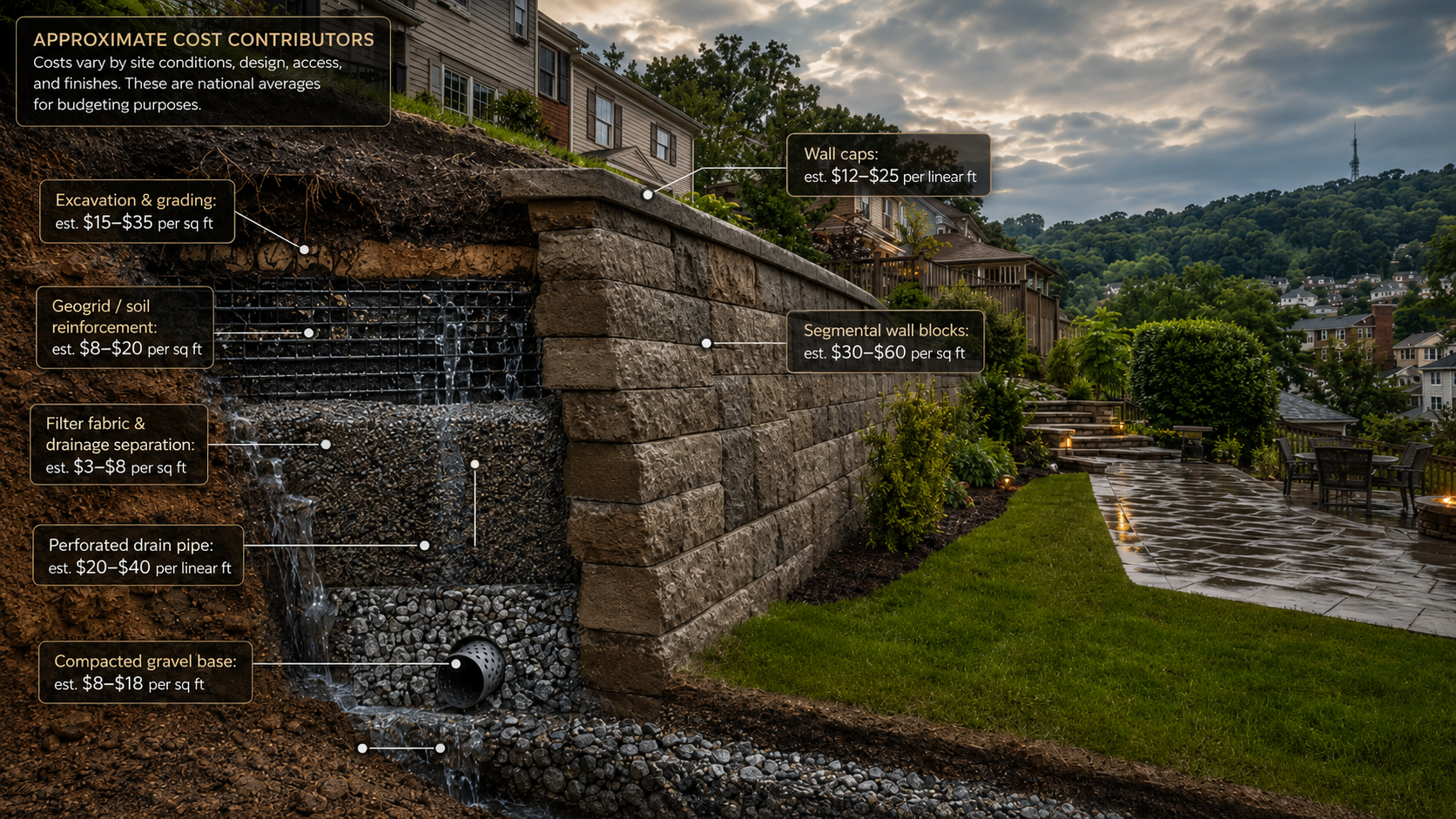
Soil naturally holds water after rain. When too much water becomes trapped behind a retaining wall, it adds pressure against the structure. This is commonly called hydrostatic pressure.
A properly designed drainage system gives water another place to go instead of letting it build up behind the wall.
Possible signs of retaining wall drainage problems include:
- Standing water
- Soil that remains unusually wet
- Water flowing through random cracks or openings
- Saturated landscaping above the wall
- Erosion that repeatedly develops after storms
Retaining wall drainage may involve properly placed stone, backfill, and perforated pipe, depending on the wall and site conditions.
If water is contributing to an existing wall problem, correcting the drainage should be part of the conversation about repair or replacement. Rebuilding a wall without addressing the water problem can leave the new structure exposed to the same conditions.
6. Part of the Wall Is Sinking or Becoming Uneven
A retaining wall can also develop problems from below.
You may notice that one end sits lower than the other, caps are no longer level, or individual sections appear to be settling independently.
Other warning signs include:
- Stair-step patterns
- Uneven wall courses
- Sinking landscaping near the wall
- Nearby pavement settling
- Sections separating vertically
Possible causes include inadequate base preparation, soil settlement, erosion beneath the wall, improper excavation, and drainage problems.
Correcting settlement usually requires more than leveling the visible blocks. First, identify the cause underneath the wall.
If the base or supporting soil is unstable, rebuilding only the top portion of the wall may not provide a lasting correction.
7. Cracks Are Growing, or the Wall Is Breaking Apart
Evaluate cracking based on the wall material and other changes occurring around it.
For concrete or masonry retaining walls, homeowners may notice horizontal cracks, large vertical cracks, cracks that continue widening, or cracking accompanied by visible movement.
Segmental block retaining walls may show different symptoms, including broken blocks, separated courses, or large shifts between sections.
Not every small crack means a wall is structurally failing.
A minor, isolated cosmetic defect differs from cracking that appears alongside leaning, bulging, soil loss, drainage problems, or settlement. A combination of symptoms can tell you more about the wall's condition than a single small crack.
Why Retaining Walls Fail in Pittsburgh
Pittsburgh properties can present several conditions that affect retaining walls. A proper evaluation should consider the entire site, not just the visible wall.
Hills and Sloped Properties
Many homes throughout Pittsburgh, Carnegie, the South Hills, and surrounding communities sit on sloped lots.
Retaining walls often manage grade changes and create more usable outdoor areas. Because these walls may hold back substantial amounts of soil, consider the slope and surrounding landscape when evaluating movement.
Heavy Rain and Runoff
Water naturally moves downhill. On sloped properties, runoff can travel toward a retaining wall and saturate the soil behind it if drainage is inadequate.
Repeated water movement can also contribute to erosion around or underneath the structure.
Freeze-Thaw Cycles
Moisture within the soil can freeze during cold weather and expand. Seasonal freezing and thawing can contribute to soil movement over time, particularly when drainage problems are already present.
Poor Drainage
Water pressure is one of the important conditions contractors consider when examining a retaining wall.
If water cannot drain properly, saturated soil can place additional pressure against the back of the structure.
Improper Base Preparation
A retaining wall depends on the base beneath it for stability.
If the base is improperly prepared or the supporting material settles, sections of the wall may sink, shift, or separate.
Soil Movement and Erosion
Changes in the soil behind or beneath a wall can gradually cause movement. Erosion, settlement, drainage, and property slope can all influence how the surrounding soil behaves.
For that reason, a Pittsburgh retaining wall contractor should evaluate conditions such as slope, soil, drainage, access, nearby structures, and the existing construction rather than judging the wall based only on its dimensions.
Can a Retaining Wall Be Repaired?
Sometimes, but it depends on why the wall is failing.
Repair may potentially make sense when problems are limited, such as:
- Individual damaged blocks
- Minor cap damage
- Small drainage corrections
- Limited erosion
- Damage confined to one section
- A wall that remains stable overall
The condition still needs to be evaluated onsite. What appears to be an isolated problem at the front of the wall may be connected to drainage, soil movement, or base problems that aren't immediately visible.
A retaining wall inspection provides more information before you begin repairs.
When Is Retaining Wall Replacement the Better Option?
Replacement may be more appropriate when the wall has widespread or significant problems.
Examples can include:
- Significant leaning
- Widespread bulging
- Major settlement
- Extensive movement
- Continued movement after previous repairs
- Major drainage deficiencies
- Improper original construction
- Severe material deterioration
- Damage that requires substantial dismantling to reach the underlying problem
One benefit of retaining wall replacement is the opportunity to address why the original wall failed.
If drainage caused or contributed to the damage, for example, a replacement project can incorporate drainage improvements rather than rebuilding the wall under the same conditions.
The same principle applies to base preparation, soil problems, erosion, or other construction issues.
It
may cost less to build a new retaining wall vs repairing the existing one, but that this point, that remains to be seen.
What Happens During a Retaining Wall Evaluation?
A retaining wall evaluation looks beyond the surface damage.
Depending on the property and wall, a contractor may examine:
- Wall height and length
- Amount and direction of movement
- Soil conditions
- Property slope
- Drainage and runoff
- Base conditions
- Backfill
- Nearby patios and driveways
- Walkways and structures
- Trees and landscaping
- Property access
- Areas that may need to be removed or rebuilt
These conditions help determine whether the problem is localized or part of a larger issue with the retaining wall system.
If you're considering replacement, factors such as excavation, base preparation, drainage, backfill, reinforcement, materials, labor, and cleanup may also affect the project scope.
Don't Wait Until a Retaining Wall Completely Fails
You do not need to assume the worst every time you find a crack or shifted block.
You also should not ignore changes that are becoming progressively more noticeable.
Consider scheduling an evaluation if you see an increasing lean, widening gaps, persistent drainage problems, soil loss, settlement, or significant cracking.
Evaluating the wall early gives you more information about its condition and your options. It can also help determine whether you can address a smaller area or whether the underlying problem requires more extensive work.
Retaining Wall Repair and Replacement in Pittsburgh
G's Landscaping works with homeowners throughout Pittsburgh, Carnegie, the South Hills, and surrounding service areas to evaluate existing retaining wall problems.
Rather than focusing only on visible damage, the team considers drainage, grading, soil conditions, existing construction, property access, and landscape needs before recommending a path forward.
If you are concerned about a leaning, cracking, bulging, or failing retaining wall, contact G's Landscaping to schedule an evaluation and discuss retaining wall repair or retaining wall replacement options for your Pittsburgh-area property.
Frequently Asked Questions
Can a leaning retaining wall be fixed?
Sometimes. Whether repair is practical depends on how far the wall has moved and what caused the movement. Drainage, soil pressure, base problems, or other structural conditions may need correction as part of the work.
How do I know if my retaining wall is failing?
Common warning signs include leaning, bulging, separating blocks, growing cracks, settlement, soil washing out from behind the wall, and ongoing drainage problems.
Is a cracked retaining wall dangerous?
Not every crack indicates an immediate structural concern. Professionals should evaluate larger or growing cracks, especially when combined with leaning, bulging, settlement, or soil movement.
Why is water coming through my retaining wall?
Water can move through or around a retaining wall because of runoff and normal soil drainage. If water collects behind the structure, the drainage system may not be directing it away from the wall.
Is it better to repair or replace a retaining wall?
It depends on the extent of the damage and what caused it. Localized problems may be repairable, while significant movement, settlement, drainage deficiencies, or improper original construction may make replacement the more practical long-term solution.